

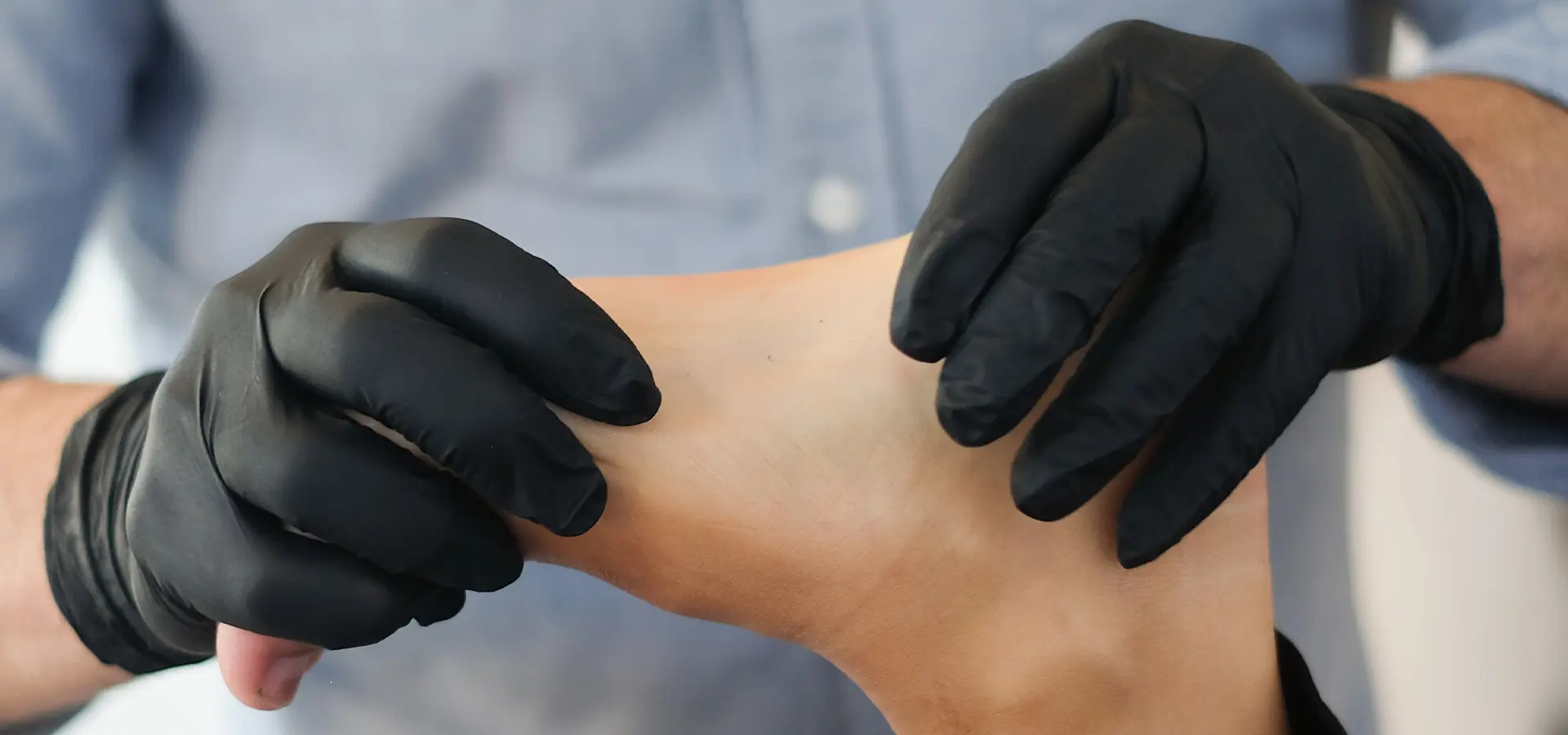
Ankle Sprain: From Roll to Ready
A single mis-step on a trail or court can leave you clutching a swollen ankle and Googling recovery timelines. Ignore it, and you risk chronic ankle instability (CAI)—the repeat-injury cycle that hampers 40 % of athletes after their first sprain. The good news: strategic rehab not only restores ligament strength but often upgrades your cutting, jumping, and hiking capacity.
Fast Facts
| What happened? | Ligaments stretched or torn by rapid inversion/eversion. |
|---|---|
| Pain zone | Lateral ankle, swelling within 30 min, tenderness over ligaments. |
| Why it lingers | Damaged proprioceptors blunt balance signals; weak peroneals fail the next cut. |
| Rehab pillars | Inflammation control → graded loading → proprioceptive & agility drills. |
Why Functional Treatment Beats Immobilization
An umbrella review of 24 systematic reviews concluded that early functional rehab—think movement plus external support—returns athletes to sport faster and with fewer stiffness issues than casting alone. Functional protocols keep collagen fibers orienting along real-world stress lines while guarding against re-injury.
The Three-Phase HolistiCare Protocol
1. Calm the Fire (Days 1–7)
- Compression wrap + elevation keep swelling at bay.
- Guided isometric dorsiflexion/eversion in pain-free ranges sparks circulation without overstressing ligaments.
2. Rewire Balance (Weeks 2–4)
A 15-week proprioceptive program in athletes with CAI improved postural control and slashed future sprains compared to controls (MDPI). We condense the essentials:
- Single-leg stance on foam (eyes closed once pain allows).
- Star excursion reaches to challenge joint position sense.
- Banded eversion + heel-to-toe walks to fire peroneals.
3. Sport-Specific Agility (Weeks 4–6+)
- Lateral hops and figure-8 cuts progress to reaction-time drills.
- Return-to-play test: hop test > 90 % of uninjured side and no pain ≥ 24 h post-session.
Shoes, Tape, and Braces—Which One?
Bracing during early functional rehab shows equal or better functional scores than tape, with similar recurrence rates. Our stance:
- Week 0–2: semi-rigid brace for protection.
- Week 3+: kinesio taping for tactile feedback as balance improves.
- Long-term: ensure footwear has a stable heel counter and torsional rigidity.
Red Flags—See a PT or MD if…
- You cannot bear weight for more than four steps.
- Numbness or tingling suggests nerve involvement.
- Swelling persists beyond two weeks despite active management.
Your Comeback Starts Here
Our clinicians blend manual lymphatic drainage, progressive loading, and sport-matching agility circuits. Athletes typically return to cutting and jumping pain-free within six weeks, often stronger than pre-injury.
Ready to rebuild confidence in every step? Call 808-348-6336 to book your FREE assessment.
FAQ
Can I run with a brace?
Yes—if pain ≤ 2/10 and no swelling the next morning. A lace-up brace can limit inversion without cramping speed.
Do I need an X-ray?
Ottawa Ankle Rules guide imaging: bone pain over malleoli plus inability to bear weight warrants radiography.
What about the RICE method?
Rest, Ice, Compression, Elevation help early, but movement within tolerance accelerates ligament remodeling.
References
Antohe, B.-A., & Panaet, E.-A. (2024). The effects of proprioceptive exercises on postural control in handball players with chronic ankle instability—A non-randomized control trial. Sports, 12(11), 304. https://doi.org/10.3390/sports12110304 (MDPI)
Gaddi, D., Mosca, A., Piatti, M., Munegato, D., Catalano, M., Di Lorenzo, G., Turati, M., Zanchi, N., Piscitelli, D., Chui, K., Zatti, G., & Bigoni, M. (2022). Acute ankle sprain management: An umbrella review of systematic reviews. Frontiers in Medicine, 9, Article 868474. https://doi.org/10.3389/fmed.2022.868474 (Frontiers)